

The Real Cost of a Cheap Tree Quote: 7 Red Flags and How to Compare Bids Fairly
- Marsel Gareyev

- Oct 30, 2025
- 6 min read
If you’ve requested a few tree service quotes and one of them is dramatically cheaper, it can feel like you just hit the jackpot. But in tree work, “too good to be true” usually means risk, shortcuts, or surprise costs—the kind that show up after the crew is already on your property (or worse, after something goes wrong).
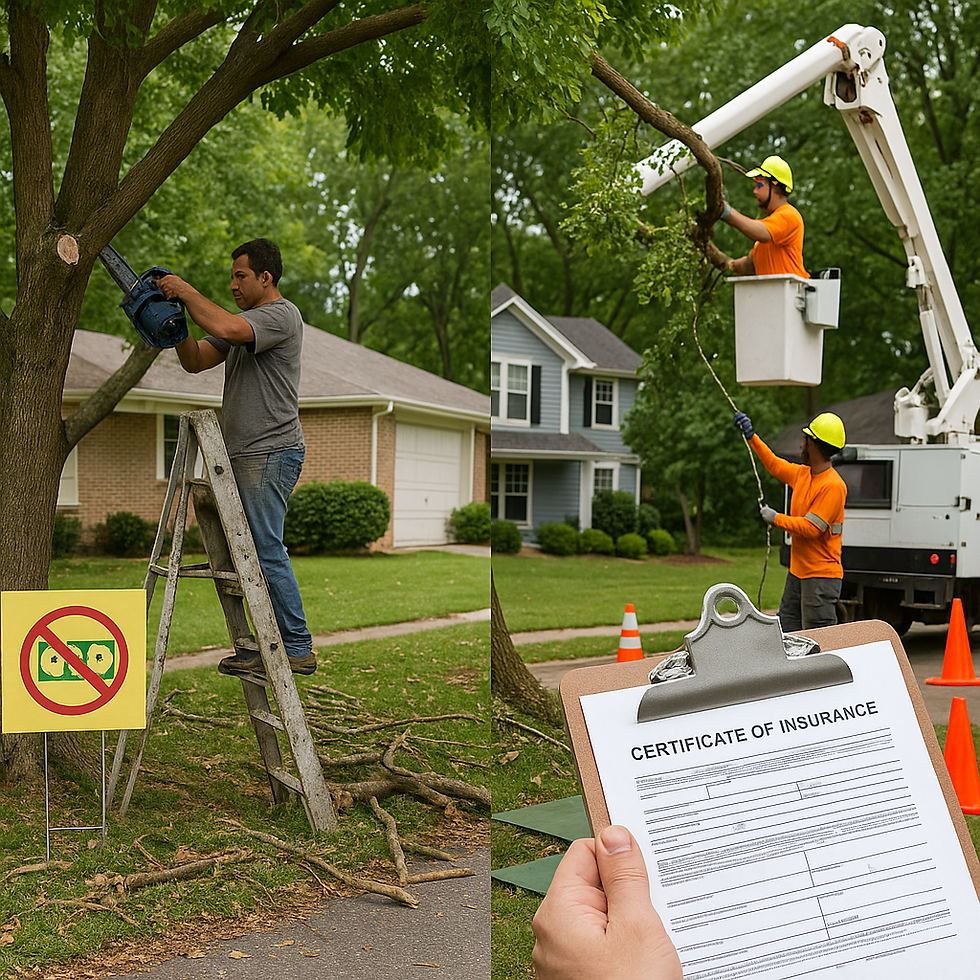
This buyer’s guide breaks down the seven biggest red flags we see in lowball quotes, how to compare bids apples-to-apples, and what to ask before you say yes. If you’d like a straight, line-itemed price from a licensed and insured team with cleanup included, grab a Free Estimate and we’ll spell everything out in writing.
Why cheap quotes get expensive fast
Tree work is skilled, high-risk labor that often requires specialized equipment, insurance, traffic control, and safe rigging. When a price is suspiciously low, the shortfall has to come from somewhere:
No or inadequate insurance (your liability)
Untrained climbers or day labor (your risk)
No permit/utility coordination (your delays and fees)
Skipped cleanup or stump work (your weekend)
Change orders after starting (your surprise costs)
A fair bid isn’t just a number—it’s scope, safety, documentation, and accountability.
Red Flag # 1: “We don’t need permits or utility coordination”
If a tree involves the public right-of-way, a sidewalk/drive lane, or proximity to the service drop, you may need coordination with the city or utility. The cheapest bids often pretend those rules don’t exist.
Why it matters: If the city stops the job mid-cut or the utility needs to de-energize, you’re on the hook for delays and fees.
What to ask: “Does this scope require any permits or utility coordination? Is that included in your price?”
What a good bid shows: A line item or note acknowledging permit/utility needs and who’s handling them.
Red Flag #2: Vague scope (“trim tree – $XXX”)
A one-liner quote leaves the door wide open for change orders or half-done work.
Why it matters: “Trim” to you might mean crown clean, canopy lift over the driveway, and selective reduction off the roofline. To the cheapest crew, it might mean “whatever we can reach from the ground.”
What to ask: “Please specify: deadwood removal? canopy lift (how many feet)? clearance off roof (how many feet)? selective reductions (which limbs/side)?”
What a good bid shows: Clear scope, e.g., crown clean (dead, dying, crossing), canopy lift to 12', 3–4' roof clearance, selective reduction over driveway, debris off-haul.
If you need a detailed, line-item proposal with options, we’re happy to provide it—start with a Free Estimate.
Red Flag # 3: No proof of insurance or licensing
Anyone can say “we’re insured.” Ask for certificates—before you book.
Why it matters: If a worker gets hurt or a limb damages the neighbor’s roof, your homeowner’s policy could be exposed.
What to ask: “Please send a current certificate of liability and workers’ comp with my address listed as the certificate holder.”
What a good bid shows: Policy limits, active dates, and contact info for the carrier.
Red Flag # 4: “We’ll decide what to do when we get there”
That’s not a plan—it’s a guess.
Why it matters: Without a defined approach (climb vs. bucket vs. crane vs. sectional rigging), crews improvise. Improvised tree work is where lawns get rutted, fences get dinged, and roofs get scuffed.
What to ask: “How will you access the tree? What equipment will you use? How will you protect my lawn, driveway, and roof lines?”
What a good bid shows: Access plan (e.g., mats over lawn, cones at street), method (e.g., controlled lowering with friction device), and named equipment (e.g., 60' bucket, mini skid, chipper).
For removals that truly need it, we’ll outline the safest approach on our Tree Removal page and in your written proposal.
Red Flag # 5: No cleanup or disposal details
The lowest quote often leaves the biggest mess.
Why it matters: Brush piles, log rounds, sawdust in gutters—“customer to dispose” can turn into days of DIY or extra fees after the fact.
What to ask: “Does your price include full debris off-haul, raking/blowing hardscapes, and gutter clean near the work area?”
What a good bid shows: A cleanup section (blow walks/drive, rake impact zones, haul chips/logs) and any optional savings for “leave wood on site” if you request it.
Our Tree Trimming and pruning jobs include neat cleanup as standard—because a job isn’t done if your yard still looks worked.
Red Flag # 6: “Cash-only today special”
Discounts are great. Pressure tactics aren’t.
Why it matters: Cash-only and “drive-by” discounts can dodge taxes, use uninsured labor, and create zero paper trail for you—no warranty, no recourse.
What to ask: “Can I pay by card or bank transfer, and will I receive a detailed invoice and before/after photos?”
What a good bid shows: Normal payment options, a dated invoice, and photo documentation upon request.
Red Flag # 7: No timeline, no weather plan, no contact person
Communication matters more than ever once saws start.
Why it matters: If the crew is late or a storm rolls in, you need to know what happens next—especially if the tree is partially dismantled.
What to ask: “Who is my on-site lead? What’s the start window, estimated duration, and rain plan?”
What a good bid shows: A named crew lead, arrival window, job duration, and a weather contingency.
How to compare bids fairly (and protect your budget)
Use this quick, copy-and-paste checklist to normalize quotes:
Scope
□ Crown clean (dead/dying/crossing) defined
□ Canopy lift target height (___ ft)
□ Roof/structure clearance (___ ft)
□ Specific reductions (e.g., driveway side, power-drop side)
□ Stump grinding (yes/no, depth ___") for removals
Safety & Compliance
□ Proof of liability & workers’ comp insurance provided
□ Permit/utility coordination included if required
□ Method noted (climb/bucket/crane) + lawn/drive protection plan
Cleanup
□ Full debris off-haul
□ Hardscape blow-down + rake
□ Optional: leave wood chips/logs by request (discount?)
Documentation
□ Before/after photos (angles listed)
□ Dated invoice with address & scope
□ Arborist notes/recommendations (maintenance intervals)
Schedule & Payment
□ Start window & job duration
□ Weather contingency
□ Payment options (card/ACH), no cash-only pressure
Send this checklist to each bidder and ask them to confirm in writing. It’s amazing how quickly the “cheap” quote either rises to a realistic number—or disappears.
What a professional, transparent bid looks like
Here’s what you can expect from All For One Tree Service:
Clear scope: We specify the exact pruning or removal work, including targets like 3–4' roof clearance, a 12' canopy lift over the driveway, and selective reductions on the house-side limbs. Explore our everyday standards on Tree Trimming.
Safety first: Licensed, insured crews using proper rigging, mats, and protection for turf, fences, and hardscapes.
No-surprise pricing: Line items for optional add-ons (stump grind, extra haul-off, utility coordination) so you can choose.
Cleanup included: Debris off-haul, rake and blowdown of work areas, and gutter check near the work zone.
Documentation: Before/after photos from consistent angles and a detailed invoice for your records (or your insurer/HOA if needed).
Respect for your property: We leave the canopy balanced and natural—no “hedge-cut” or topping.
Need a removal? We’ll outline safe sectional rigging or crane assist on the Tree Removal side, and give you options for stump handling (flush cut, grind now, or later).
Common “sneaky” extras to watch for
Stump not included: A removal price that excludes stump grinding (and surface roots) can add hundreds later.
“Brush only” haul-off: Logs left behind because “that wasn’t included.” Ask for full off-haul unless you want firewood.
Access damage: No ground protection plan? You might inherit ruts. Mats and smart access prevent that.
Utility surprises: Work paused because the service drop is too close. If coordination’s needed, it should be in the bid, not a day-of shock.
Change-order ambush: Vague quotes morph mid-job. Detailed scope = fewer surprises.
When a higher bid actually saves you money
Paying a little more up front often prevents:
Property damage claims (fence panels, gutters, shingles, irrigation)
Follow-up fixes when a quick hack job regrows ugly and fast
Insurance headaches if something goes wrong on site
Lost weekends dealing with debris or a stump you didn’t plan for
A professional job protects your time, property, and peace of mind—and keeps your trees healthier long-term.
Ready for a fair, transparent quote?
If you’ve got a low number in your inbox and your gut isn’t sure, send it to us. We’ll walk you through the scope and show you how our plan compares—line by line—so you can choose confidently.
Get a Free Estimate with a clean, detailed scope
Learn more about safe Tree Removal when it’s truly necessary
Keep canopies healthy with professional Tree Trimming and structural pruning
Bottom line: The cheapest quote isn’t the best value if it risks your property, your insurance, or your weekend. Choose the crew that’s honest, insured, and cleanup-included—then hold every other bid to that standard.


