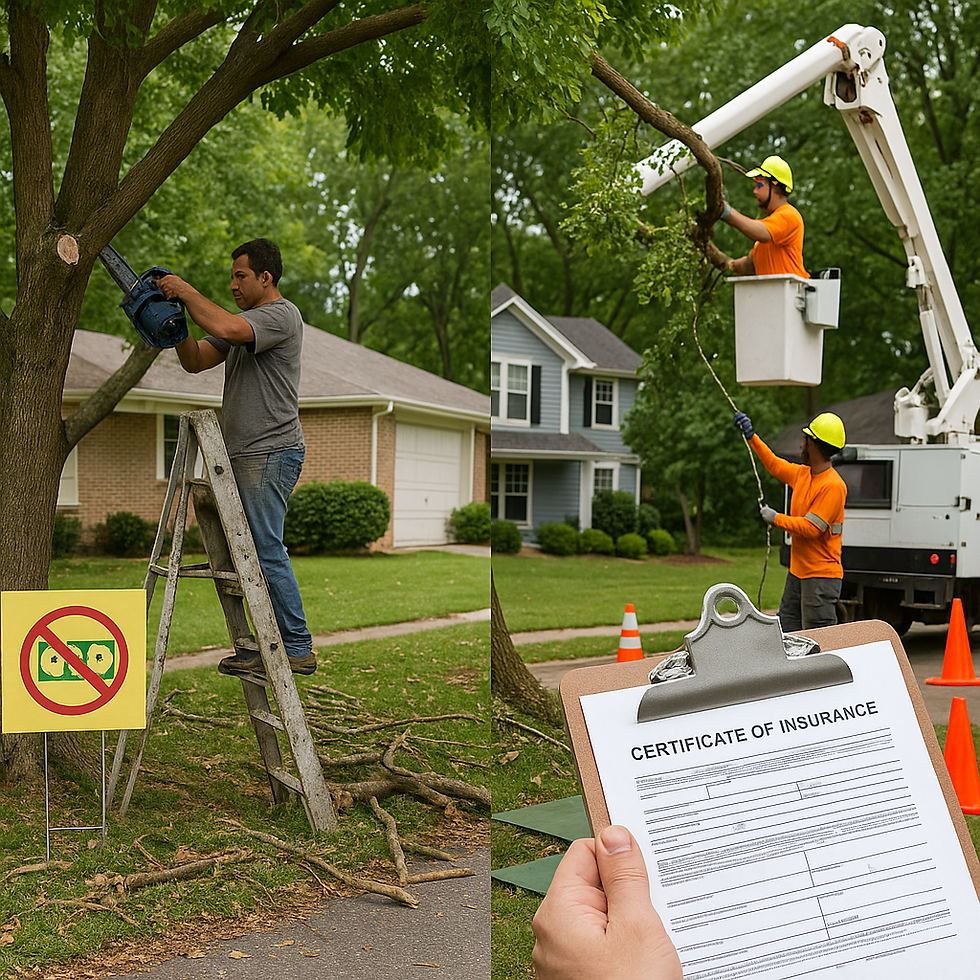
HOA and Permit Basics for Tree Work in Douglasville: A Quick Homeowner Playbook
- Marsel Gareyev

- Dec 22
- 5 min read
Nothing stalls a simple tree project faster than paperwork confusion. Between HOA approvals, utility locates, and city rules, it’s easy to wonder, “Can we just cut the thing already?” This quick playbook shows Douglasville homeowners exactly who to notify, what to file, and when—so your project moves from quote to clean yard without the dreaded back-and-forth.

If you want us to quarterback the whole process, request a Free Estimate and we’ll outline the approvals and documentation for your address. For urgent removals or storm damage, jump straight to Tree Removal and (if needed) Stump Grinding.
Step 1: Identify your decision-makers (HOA vs. City vs. Utility)
HOA/Neighborhood Association (if applicable)
Most HOAs require an Architectural Review Committee (ARC) approval before removing trees visible from the street or within front/side yards. Some also regulate trunk size thresholds (e.g., any tree over X inches DBH) or species.
City/County
Local requirements vary by parcel and zoning. In many residential cases, routine pruning and single-tree removals on private property don’t trigger a formal permit, but you may still need to document hazardous trees for insurance/HOA files or coordinate if the tree is near the right-of-way.
Utilities
If roots or canopies are near overhead service drops or underground lines, coordination matters. You or your contractor should request 811 utility locates before any digging (stump grinding, new plantings, footers, irrigation work).
Not sure which apply? During your estimate, we’ll check HOA guidelines (if provided), call out any city/utility touchpoints, and note whether 811 locates are needed.
Step 2: What HOAs typically want (and how to get a fast “yes”)
A short explanation:
Which tree(s), where on the lot, and why (e.g., hazardous lean, storm damage, foundation/driveway conflicts, dead/dying).
Photos that tell the story:
Front view, house-side view, close-ups of decay, lean, or root conflicts.
A professional plan:
Our written scope: e.g., “sectional removal of 22” willow oak; rigging to protect roof and drive; full debris off-haul; **Stump Grinding to ~6–8” below grade; replant with approval.”
Proof of insurance/licensing:
We can supply COI/credentials with your address listed as certificate holder if the board requests it.
Replanting note (optional but helpful):
Many boards like to see what’s going back in. We can suggest size-right replacements.
Pro tip: Send a single, tidy PDF (photos + proposal + insurance cert). ARC reviewers love concise packets.
Step 3: When you actually need an 811 locate (and when you don’t)
Call 811 at least 2–3 business days before any work that disturbs the soil:
Stump grinding (even “just a few inches”)
New plantings, fence posts, landscape lighting, or irrigation trenching
Root barrier installations or sidewalk repairs
You usually do not need an 811 ticket for above-ground trimming only. If you book Stump Grinding with us, we’ll handle the locate timing and mark windows so grinding happens safely.
Step 4: City/Right-of-Way realities
Right-of-way trees: If a tree sits partly in the public strip or impacts sidewalks/streets, we may need coordination with the city before closure or traffic control.
Traffic control: For large removals on tight streets, cones and spotters may be required; we include that in our plan when needed.
Storm damage: Emergency hazard mitigation often moves faster—document the hazard, then remove safely. We provide the after-action documentation your insurer may ask for.
Step 5: The paperwork your HOA, city, and insurer actually read
We provide a clean, shareable packet you can email or upload:
Proposal / Scope of Work (address, date, methods, protections, cleanup, stump plan)
Before photos (wide and detail angles)
Insurance certificate (upon request)
Post-work photos (same angles for easy comparison)
Paid invoice (proof of completion)
Arborist note (if needed, summarizing hazard/cause and recommending maintenance intervals)
Step 6: A realistic timeline (so you can plan)
Day 0–1: Request a Free Estimate. We visit, scope, and flag any approvals needed.
Day 1–3: You submit the packet to your HOA (we can supply a ready-to-send PDF). If stump work is planned, we open the 811 ticket.
Day 3–10: HOA/ARC review window (varies). Utility locates mark the yard.
Day 7–14: We schedule the work, coordinate any city or utility touchpoints, and execute.
Day 14–15: You receive photos and final documentation for your files.
Need to move faster for a hazardous tree? Tell us at booking—we’ll prioritize a safe plan through Tree Removal and provide the documentation trail retroactively for the HOA/insurer.
What trips homeowners up (and how we avoid it)
“We thought pruning didn’t need approval.”
Some HOAs still want to review front-yard canopy changes. We’ll phrase the scope as risk mitigation, not cosmetic topping (which we don’t do).
No locate before grinding.
Stump grinders go deeper than you think. We always match grinding depth to root/repair goals and call 811 first.
Vague proposals.
Approvers dislike fuzzy terms. Our scopes are plain English: “canopy lift to ~12’ over drive; 3–4’ roof clearance; sectional rigging away from house; full debris off-haul; stump grind to 6–8”; tidy backfill.”
Right-of-way surprises.
If a street lane or sidewalk could be impacted, we plan protection and, when needed, basic traffic control to keep everyone safe (and keep the job moving).
Easy copy-and-paste HOA email (replace brackets)
Subject: Tree Work Request – [Address], [Lot #]
Hi ARC Team,
We’re requesting approval to complete tree work at [address].
Reason: [hazardous lean/decay], [driveway lifting], or [storm damage].
Scope (by licensed/insured contractor):
• Sectional removal of [species/size] or structural pruning for [species]
• Rigging to protect roof/drive; full debris off-haul
• Stump Grinding to ~6–8” below grade (811 locate requested)
• Optional replanting: [species/size], if required
Attached: photos (before), proposal, proof of insurance (upon request).Thanks for your review—happy to answer questions.
Best,
[Name]
[Phone/Email]
FAQ (fast answers you can put on your ARC form)
Do I need approval for pruning only?
If the tree is visible from the street, many HOAs still want a quick review. We’ll provide a scope that emphasizes safety and tree health (no topping).
Who calls 811?
If grinding or digging is in the plan, we can open the ticket and schedule work after marks are down.
Can I keep wood or chips?
Yes—tell us at approval time. Otherwise, our default is full off-haul so the yard is inspection-ready.
What if the board asks for proof of hazard?
We can include an arborist note and photos in your packet, plus after-photos when complete.
Ready to make this painless?
We handle the logistics, you get the results—and a tidy folder of documentation for your HOA and insurer.
Get a Free Estimate with a clear approval checklist
Book safe Tree Removal when a tree has to go
Add Stump Grinding with 811 locates handled
Bottom line: A little paperwork up front beats weeks of delays. We’ll line up approvals, protect your property, and leave clean proof that the work was done right.