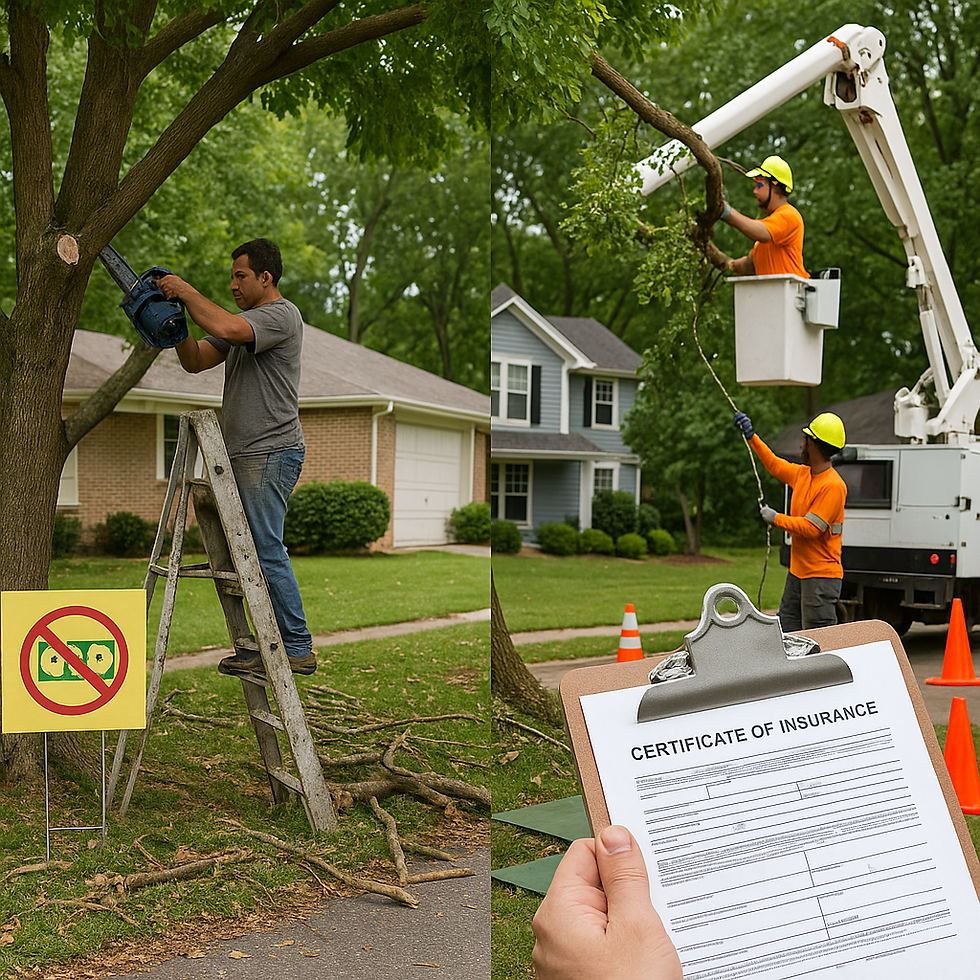
Home Insurance Inspections in Douglasville: Pass on the First Try with Proper Tree Clearance
- Marsel Gareyev

- Oct 24, 2025
- 6 min read
If your insurer just scheduled a home inspection in Douglasville (or you’re switching policies), there’s one thing that can fail an otherwise clean report: trees that are too close to the house, roof, driveway, or power drop. The good news? With the right prep—and a little help from a certified arborist—you can pass the first time, avoid premium hikes, and keep your property safer year-round.

Below is a plain-English checklist our team uses when we get calls like, “The insurance company flagged my trees—what do I do?” Use it to get inspection-ready, fast.
Why insurers care about tree clearance
Insurers aren’t anti-tree. They’re anti-avoidable claims. Overgrown limbs and neglected trees are a leading cause of:
Roof leaks from rubbing limbs and clogged gutters
Wind damage and shingle lift
Branches dropping on vehicles/driveways
Power disruptions from limb contact at the service drop
Trip hazards and uplifted concrete from roots
Moisture and pest issues where canopy traps shade against siding
A clean clearance plan shows you’re reducing risk. That usually means fewer follow-ups from the inspector—and fewer headaches for you.
The inspector’s playbook (what they actually look at)
While each carrier is a little different, most inspections in Douglasville focus on:
Roof & Gutters
Are limbs hanging over the roof?
Are branches rubbing shingles or the fascia?
Are gutters packed with leaves and seed pods?
Siding & Windows
Is foliage touching the siding (trapping moisture)?
Are branches scraping window screens?
Driveway & Walkways
Is there safe, unobstructed vehicle and pedestrian clearance?
Any root heave lifting slabs or creating cracks?
Yard & “Targets”
Playsets, sheds, AC units, fences, and parked vehicles under branchy areas
Deadwood or storm-damaged limbs above high-use zones
Power Service Drop (very important)
Limb encroachment near the overhead line where it meets your home (the “service drop”).Note: Work around energized lines is not DIY. Insurers expect proof you used qualified pros.
If you want us to walk your property with the same lens an inspector uses, book a quick Tree Inspection and we’ll document exactly what to fix and how.
Clearance cheat sheet (Douglasville homeowner edition)
These are practical, pass-the-inspection targets our arborists use on residential properties. Exact requirements can vary by utility and insurer, but these benchmarks keep most homes out of the “needs correction” bucket:
1) Roof & fascia
Aim for visible sky between roof edges and foliage—no contact, no rubbing.
Trim back limbs that overhang shingles so wind gusts can’t drag or scuff them.
Keep 2–3 feet of breathable space between shrubs and siding to prevent moisture and pest issues.
Need a clean, natural look (not a hacked, flat line)? Ask for structural Tree Pruning rather than a quick hedge-style chop. It looks better and regrows better.
2) Gutters & valleys
Remove overhang that constantly dumps leaves/pine straw into gutters and roof valleys.
Consider a seasonal canopy lift over low gutters so water and debris don’t collect.
A targeted Tree Trimming visit before inspection can save you from “maintenance required” notes on the report.
3) Driveway & walkways
Ensure vehicles can pull in without branches scraping roofs or mirrors.
Provide clear headroom so guests and delivery drivers aren’t ducking limbs.
Flag any root-raised slabs or cracks—and note a remediation plan (your insurer loves to see “identified + scheduled”).
If roots are the culprit, we can advise on root-friendly fixes that protect the tree and the concrete.
4) Yard “targets”
AC condensers: maintain a clear vertical cone above the unit so sticks/leaves don’t clog coils.
Fences & sheds: prune back branches that rub or drop debris against surfaces.
Play areas: remove deadwood and weakly attached “hanger” limbs directly overhead.
5) Power service drop (no DIY here)
If you see limbs near the power line to your home, stop and call us. Clearing in that zone requires specific qualifications and coordination with the utility. Insurers take this area seriously; we’ll handle it safely and document everything for your file.
Documentation your insurer will actually read
When we prep clients for inspection, we don’t just do the work—we leave a paper trail you can email straight to your agent or upload to the carrier portal:
Before/after photos from the same angles (roof edges, driveway approach, service drop area, AC unit)
Work order & invoice listing the property address, date, scope (e.g., “canopy lift over roof and drive, deadwood removal, line-clearance coordination”)
Arborist notes on tree health and any next-step recommendations (e.g., re-check in 12 months, crown-reduce storm-split limb if it worsens)
Utility coordination record (if service-drop work was required)
Schedule your pre-inspection Tree Inspection and we’ll package these for you.
30-Day Prep Plan (steal this)
Day 1–3: Walk-through & photosTake wide shots of roof edges, gutters, drive approach, walkways, AC unit, and the service drop. Make a “punch list” of anything touching, rubbing, scraping, or overhead where it shouldn’t be.
Day 4–7: Book the workGet on the calendar for targeted Tree Trimming and structural Tree Pruning. If there’s service-drop encroachment, tell us up front so we can coordinate.
Day 8–20: Execution & cleanupWe’ll prune, remove deadwood, lift canopies, and clear the problem zones. Debris off-haul included.
Day 21–25: DocumentationWe capture after-photos and produce a simple one-page summary you can send your carrier.
Day 26–30: Inspector-proofingDouble-check gutters and walkways (a windy day can blow fresh debris). If the inspection date shifts, you’ll still be ready.
Red-flag items that almost always get cited
Dead or dying limbs over the roof, driveway, or play zones
Limbs physically resting on shingles or visibly abrading the fascia
Heavy overhang that keeps gutters perpetually clogged
Encroachment near the power service drop (again: not DIY)
Obstructed driveway approach—branches scraping vehicles
Mushrooms, trunk cracks, or lean changes on a large tree near the house (inspector may request an arborist letter)
If you spotted any of the above on your walk-through, jump straight to a Tree Inspection. We’ll prioritize those issues first.
Pruning vs. removal: what passes (and what pays off)
Most Douglasville homes don’t need removals to pass inspection. Strategic pruning usually does it:
Crown cleaning: remove dead, dying, and weakly attached limbs
Canopy lift: raise low branches over the roof, drive, and walkways
Selective reduction: shorten specific limbs to relieve weight and increase wind clearance
When removal is the right call (decay, severe lean toward a structure, root failure concerns), we’ll explain why, show you the evidence, and (if you want) keep the stump low for future grinding or turn logs into usable mulch.
DIY or call a pro?
DIY works for low ornamental shrubs away from the house. Keep foliage off siding and leave some air gap so walls can dry after rain.
Call a pro for anything over a roof, near windows, or within striking distance of vehicles—and always for anything within reach of the service drop or other energized lines.
Our crews use rope systems, rigging, and controlled lowering to avoid roof dings and landscape damage. It’s not just safer; it leaves a cleaner result (and better photos for your insurer).
“Can you just write a note for my carrier?”
Yes. After a Tree Inspection, we can provide:
A short arborist letter confirming work completed and current condition
A maintenance plan (e.g., re-evaluate in 12 months; seasonal canopy lift on the oak over the driveway each spring)
That kind of proof often stops the “we need more information” email chain.
Douglasville-smart tips (local realities we see every week)
Summer thunderstorms: Prune before the daily storm cycle ramps up; freshly cut limbs shouldn’t be tested by the first big gust.
Pine straw & leaf drop: Plan a late-fall touch-up if your gutters fill fast—inspections sometimes get rescheduled.
Clay soils: Watch for tilt or heave after heavy rain; if a large tree’s lean suddenly changes, call for an urgent assessment.
HOAs: If you’re in a neighborhood with tree rules, we’ll align your clearance plan with the covenants so you’re right with both the HOA and the insurer.
Ready to pass on the first try?
If your inspection is on the calendar, we can usually slot a clearance-focused visit within your timeline and give you the documentation your carrier wants. Start with a quick Tree Inspection, and we’ll map the exact Tree Trimming and Tree Pruning needed to pass—without butchering the look of your property.
Bottom line: You don’t need a chainsaw makeover to satisfy insurance. You need thoughtful clearance, clean documentation, and a plan you can show in writing. We’ll handle all three.